Not Your Typical Orchestra: Get to Know the Instruments of the Washington Balalaika Orchestra
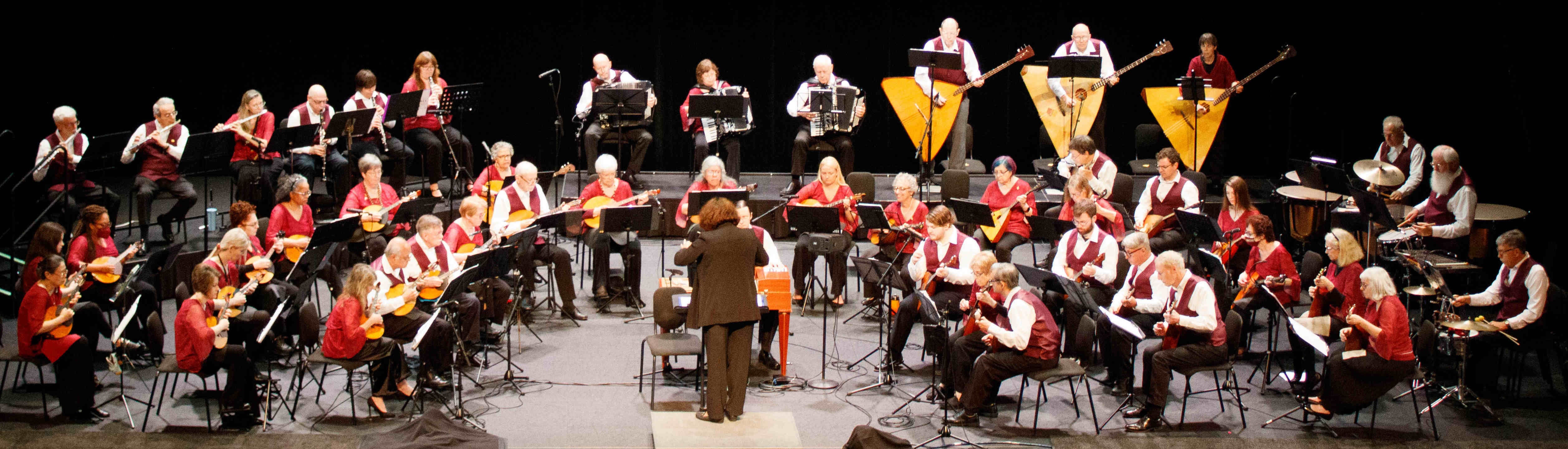
A triangle-shaped string instrument. A folk accordion with concert-hall power. A centuries-old harp-like instrument.
No, this isn’t fantasy movie music—it’s the sound of the Washington Balalaika Orchestra, coming to Capital One Hall on June 14.
From Tchaikovsky to Gershwin, waltzes to klezmer, this 55-person orchestra performs music you may recognize (such as music from “Swan Lake")—using instruments many audience members are seeing for the very first time.
Before the concert, take a closer look (and listen) at the fascinating instruments that make this performance so unforgettable.
Balalaika: The Balalaika family of instruments includes, from the highest-pitched to the lowest, the prima balalaika, sekunda balalaika, alto balalaika, bass balalaika and contrabass balalaika. All have three-sided bodies, spruce or fir tops and backs made of from three to nine wooden sections, and all have three strings. The prima balalaika is played with the fingers, the sekunda and alto either with the fingers or a pick depending on the music being played, and the basses and contrabasses (equipped with extension legs which rest on the floor) are played with leather picks.
Domra: The Domra family of instruments includes, from the highest-pitched to the lowest, the prima domra, alto domra, tenor domra and bass domra. All have round or oval faces and rounded backs made of from five to nine sections. Each of these is available in either a three-stringed or four-stringed version. The three-stringed domra family is tuned in fourths, and the four-stringed family in fifths (similar to the violin family). All of the domras are played with picks.
Bayan: The bayan is a Russian version of the accordion, with rows of buttons on both the left and right sides. Many players consider that this arrangement gives the player more flexibility than the piano-key arrangement on the more familiar accordion, and that rapid and complex passages can be played with greater ease. The reed structure is different from the piano accordion as well.
Gusli: This instrument, also called a table psaltery, is thought to be more ancient in origin than any of the other plucked instruments in the orchestra. Somewhat akin to the Autoharp in concept (but much larger, contained within a table with legs), the notes to be played are controlled by a one-octave piano keyboard controlled by the left hand, and the right hand uses a leather pick or individual fingers to broadly stroke or individually pluck the notes. The Orchestra uses two guslis in many concerts.